WORCESTER STONE WALK
Wednesday 16th October 2013
This walk followed the Earth Heritage Trust trail guide entitled “Worcester City Centre”. This can be purchased from Herefordshire and Worcestershire Earth Heritage Trust; Geological Records Centre; University of Worcester; Henwick Grove; Worcester WR2 6AJ (01905 855184) ; cost around £2. Note that most of the pictures were taken on the recce, when it was beautiful sunshine!
The wind howled and the rain poured as about a dozen intrepid geologists set out to follow the Worcester Stone Walk, led by Janet Parry and Richard Newton.
We started at the Guildhall which is mostly built of brick, but decorated with an oolitic limestone called Bath Stone. Oolitic limestone was originally formed on the bed of a warm shallow tropical sea. It is made of millions of tiny spherical grains (ooliths) and fossil shell debris which have been rolled around by the action of strong currents on a sea bed of calcium carbonate mud. Layers of calcium carbonate got added to the tiny spheres which eventually became buried under new sediment. The ooliths can clearly be seen using a hand lens — they look a bit like cold tapioca, that hated pudding of our schooldays!
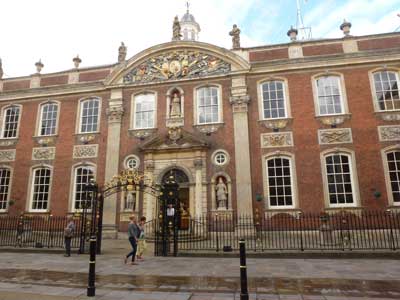
The Worcester Guildhhall.
We splashed on to St Helen’s Church where the stone around the central window is also a limestone, but this one is full of fossils. We tried to identify the broken shells of clams and oysters. Most of the building is red, because it was built using New Red Sandstone which was probably quarried locally, near Ombersley. This rock was formed from sand deposited in temporary streams and in a river which flowed across a desert in the Triassic Period, 230 million years ago. The redness is due to iron oxide which coated the grains in the sand. Because of erosion, some of the stones in the porch have been replaced, but with a red sandstone from Annan in Scotland — this is also Triassic in age. Since the light was very poor and it was still teeming with rain, we failed to see fragments of mica sparkling in the sunshine!
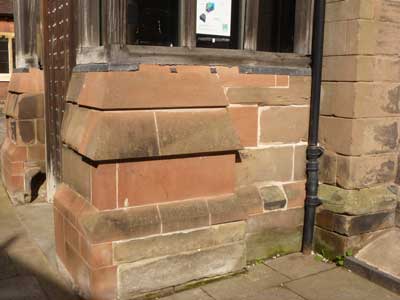
Repairs to the porch in St. Helen’s Church.
We walked quickly past the fire station in torrential rain, merely glancing at the expensive white limestone from which it is built. Portland Stone, from the Isle of Portland in Dorset, has been used to build many famous buildings in this country, eg. St Paul’s Cathedral in London. This limestone was formed on the bed of a warm shallow sea in the Jurassic period, about 150 million years ago. We barely stopped to look for fossils, we were too cold and wet.
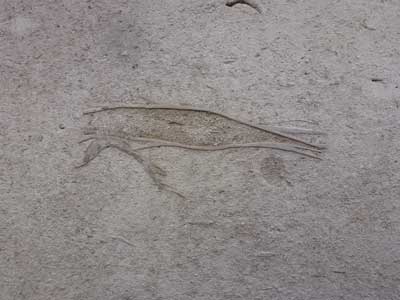
A fossil in the Portland Stone wall, the Fire Station.
We trudged on through the downpour to the Cathedral where we stood in the porch while Janet explained what we were going to see. There was a slight lull in the rain, so we made the most of it for the next few minutes. A great variety of stone is present in the cathedral walls where repairs have been carried out at many times in the past, and major restoration is still ongoing. We looked at the wall to the right of the porch where the old stonework is badly flaked and weathered. The greenish-grey stone is a Carboniferous limestone called Highley Stone. This comes from the Severn Valley, close to the old Wyre Forest coalfield. The outside wall of the west side of the porch is made from blocks of sandstone known as Bromsgrove Red. This is a rich reddish-brown Triassic sandstone, and probably comes from nearby Holt or Ombersley.
( The Formation of Sandstone. As the land is eroded, small particles of rock are carried away by wind and water to be deposited on river beds, in deserts or on the seabed. Sand-sized particles may accumulate to a thickness of many metres of sediment. Over time, the sediment is buried, compressed and cemented into a hard rock called sandstone. )
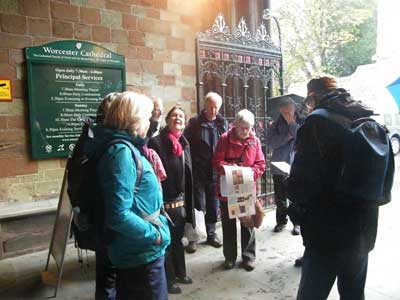
Sheltering out of the rain in the Cathedral porch.
The rain came back with a vengeance, so we thankfully retreated to the small café in the cathedral cloisters for a coffee break. Before we left the sanctuary of the church, we had a look at the stones in the cloisters — which we could do under cover. The cloisters were rebuilt in the 14th and 15th centuries, and as a result there are several different types of rocks in the walls. The light brown ones are Carboniferous Sandstone and the reddish ones are Triassic Sandstone. The light was poor, but one of our number had the foresight to bring a torch! So we were able to look at cross-bedding within the stones, one of which had been inserted upsidedown! How dare they?
Once more unto the breach, dear friends…….!
Rivers of water flowed over the paving slabs of Friar Street as we were looking at the Fly Flats Yorkstone from which they were made. This is a Carboniferous sandstone from Highmore in Yorkshire. The brown lines and rings in the slabs are bands containing a high concentration of iron. They developed after the layers of rock had been consolidated, so they cut across them. In the greyness and gloom there was no hope of seeing particles of mica sparkling in the sunshine, so we moved quickly on.
Some of us had no idea that remnants of the 13th century city walls still existed, so that was a pleasant surprise. They were built using Triassic New Red Sandstone, the same rock used to build St Helen’s Church. The blocks are very weathered, having been in situ for the past 750 years.
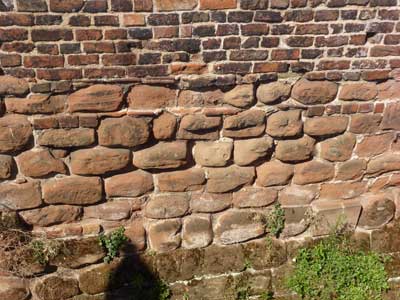
The city walls.
By now several of us were realising that our waterproofs were not as waterproof as they used to be, and one or two persons had politely sneaked off home. We had a quick glance at the marble cladding on the walls of M&S. Marble is a Metamorphic Rock, that is one that has been altered by heat and/or pressure but not to the extent that it has actually melted. The white lines we could see in the marble are veins of Calcite which formed from hot fluids passing through cracks in the rock when it was being changed from a limestone to a marble deep within the Earth’s crust.
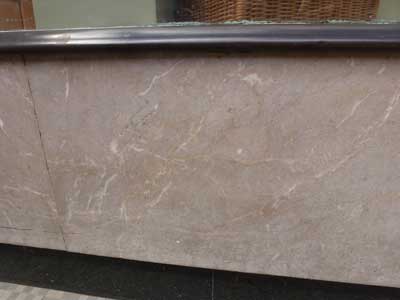
Marble cladding on the frontage of M&S.
By this time a few of us were sloshing in our shoes and shivering with the cold. So we turned our steps towards our lunch stop at the Museum. We passed the Lloyds TSB building which is built of Bath Stone, an oolitic limestone similar to that used in the building of the Guildhall. Some of the ooliths have been dislodged leaving rounded pits, and there are many broken pieces of shell. This indicates a strong current on the original seabed while the rock was being formed. The columns in front of the building are made from Corennie Pink Granite from Aberdeenshire. Granite is an Igneous Rock which forms when a large molten mass cools slowly deep within the earth’s crust, forming large crystals of the different minerals. The pink and white crystals are Feldspar, the greyish-white glassy material is Quartz, and the blackish-brown mineral is a black mica called Biotite.
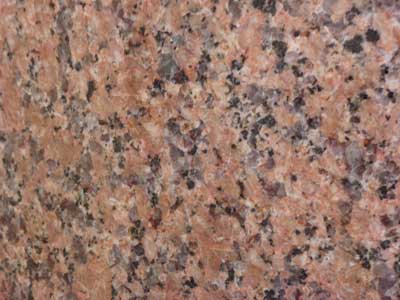
Corennie Pink Granite from Aberdeenshire on the Lloyds TSB building columns.
We all agreed to end the trail there, and make a bee-line for the museum restaurant before anyone died of hypothermia!
Thank you, Janet and Richard, for organising such an interesting morning — such a pity about the weather! (Ironically, as we returned to Malvern on the bus in the early afternoon, the clouds rolled away and the sun came out!)